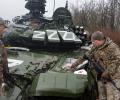
'There is no such thing as ultimate survivability.'
'It's all comparative -- who outperforms, who uses tactics, who optimises technology to the best is what makes the difference.'

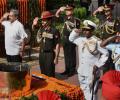
India's military prowess and multi-hued images of the country's rich cultural diversity and achievements in various fields were on display at the majestic Rajpath on Tuesday during 67th Republic Day parade which was graced by French President Francois Hollande as the chief guest.
India has experienced hands and will emerge with flying colours, declares Inspector General Gurdip Singh Uban (retd).

All equipment from the Army which were part of the Republic Day celebrations are made-in-India, Chief of Staff Delhi Area Maj Gen Bhavnish Kumar had earlier said.
Amongst those who heard the message of the Bihar results would be Defence Minister Manohar Parrikar, whose realm is simultaneously the country's most complex and -- when something goes wrong -- the most emotive, says Ajai Shukla.
Indian military sources said no firearms were used in the clashes and that most of the injuries were sustained following stone-pelting and use of rods by the Chinese side.

'The Chinese can't be trusted hence the need to verify and re-verify.'

In a major boost to its fire power, the Indian Army has deployed a sizeable number of upgraded L70 anti-aircraft guns in the high mountains along the Line of Actual Control in Arunachal Pradesh in addition to its existing M-777 howitzers and Swedish Bofors guns, officials said on Wednesday.
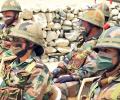
On the shopping list: Light tanks, anti-tank guided missiles, UAVs, assault rifles, fighter aircraft.

'My adrenalin kicked in and the happiness returned! It was time to go in for the kill again.' IAF Veterans Group Captain Dilip Kumar Dass tells Air Commodore Nitin Sathe about how the IAF decimated tanks in the famous Battle of Longewala.
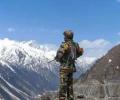
The Heron unmanned aerial vehicles are already in the Air Force, Navy, and the Army and are being used extensively at the moment by both Army surveillance and Target acquisition batteries and Air Force in the Ladakh sector.
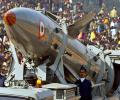
Will private firms really boost Make in India in the defence sector? Ajai Shukla seeks answers.
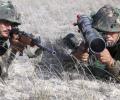
Here is how the two countries stack up militarily, according to a report in AlJazeera.com.

The SpyLite aerial system will help our soldiers in border flashpoints like Doklam and in encounters with terrorists in Kashmir.

The army has long been deficient in artillery, the modern battlefield's most lethal killer, says Ajai Shukla.

'It is the government's most important duty to ensure that when war breaks out, the armed forces are absolutely ready to face the adversary -- well equipped, well trained and in high spirits,' says Brigadier Gurmeet Kanwal (retd).
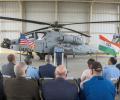
Its advanced Longbow radar picks up enemy armoured vehicles and then destroys them with anti-tank missiles, air-to-surface rockets or a chain gun that sends 625 rounds per minute ripping into the targets.

'It is a game of patience. We have to stand firm and tire them out, which we are doing.'
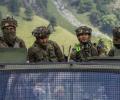
Today, the Ladakhis and Tibetans have been joined by the Sikhs, the Madrassis, the Garhwalis, the Rajputs, who are well trained psychologically and otherwise, to defend the nation, observes Claude Arpi.

'The defence minister needs to focus on human resources-related issues at the same pace in 2017 as he did on acquisitions in 2016,' says Brigadier S K Chatterji (retd).

Sources indicated that during Saturday's talks, India will insist on a faster disengagement process in remaining areas to bring down tension in the region, which has witnessed a tense standoff between the two militaries for over nine months.
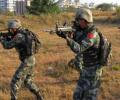
The brigade that conducted the drills was from the PLA's Tibet Military Command and is one of China's two plateau mountain brigades.

A round-up of our favourite photographs from the week gone by.

At war, the Jalashwa can carry and launch a full infantry battalion in a single wave. At peace, the Jalashwa can evacuate 1,000 people in a single trip. Ajai Shukla explains why the Indian Navy's new tender for more ships like the Jalashwa must be treated with special urgency.

On display was India's military might and cultural diversity.

'This, together with Chinese revisionism, will constitute the major test of the international system.'

The winners of the annual US Military Photographer of the Year competition showcase the compelling body of work military photographers compiled in 2014.

'We must acknowledge China will use Pakistan against India.' 'We all need to know that these two countries are ready to destabilise India at all times.'

'Captain Vikram Batra, PVC and his unit 13 Jak Rif did stand out because of the sheer magnitude of the task allotted to them but also the exceptional professionalism with which it was executed and completed,' recalls Lieutenant General Syed Ata Hasnain (retd).
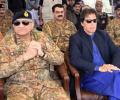
'Any conventional conflict could trigger a nuclear war with results that neither India nor Pakistan could survive easily.' >A revealing excerpt from Shuja Nawaz's The Battle For Pakistan: The Bitter US Friendship And A Tough Neighbourhood.
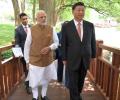
'India's preference today seems to be to exploit the deepening chill in relations with China to breathe new life into its meandering partnership with the US,' argues Ambassador M K Bhadrakumar.
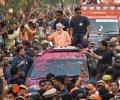
The 3,000-strong force, plus its highly trained dog squad, is responsible solely for the protection of one person: Prime Minister Narendra Damodardas Modi.

UAVs are an intrinsic part of today's technology driven battlefield. Indians don't seem to be taking the challenge with the degree of urgency that is required, says Brigadier S K Chatterji (retd).

Evacuation of people from the family quarters is in progress.

It's troubling times at the Line of Control with the Indian Army personnel fighting off terrorists who have been trying to infiltrate into India. On Thursday morning, a jawan was killed and three others were injured after a fierce gunbattle broke out between security forces and the terrorists who had sneaked into Arnia border sector while another infiltration bid was foiled along the Line of Control in Rajouri district.

'Pakistan's security establishment, despite its appallingly immoral approach to conflict, has worked with limited resources to maximise its national defence resources to continue bleeding India,' says Ajai Shukla.

Just 21 then, a young air force officer looks back at the 1971 war, which was like a baptism by fire in the fauj.
